

The News
The letter was old when it reached him — carried by cart, then boat, then cart again through the spring mud, and delivered by a merchant’s boy who did not know what he carried.
Poliphilos unrolled it by candlelight in the guest-room of the monastery where he was staying. It was not addressed to him; it was one of a bundle, a factor’s report from a northern port, written for his employer’s eyes, full of grain prices and toll complaints. Nine parts dull.
Then there was the tenth part:
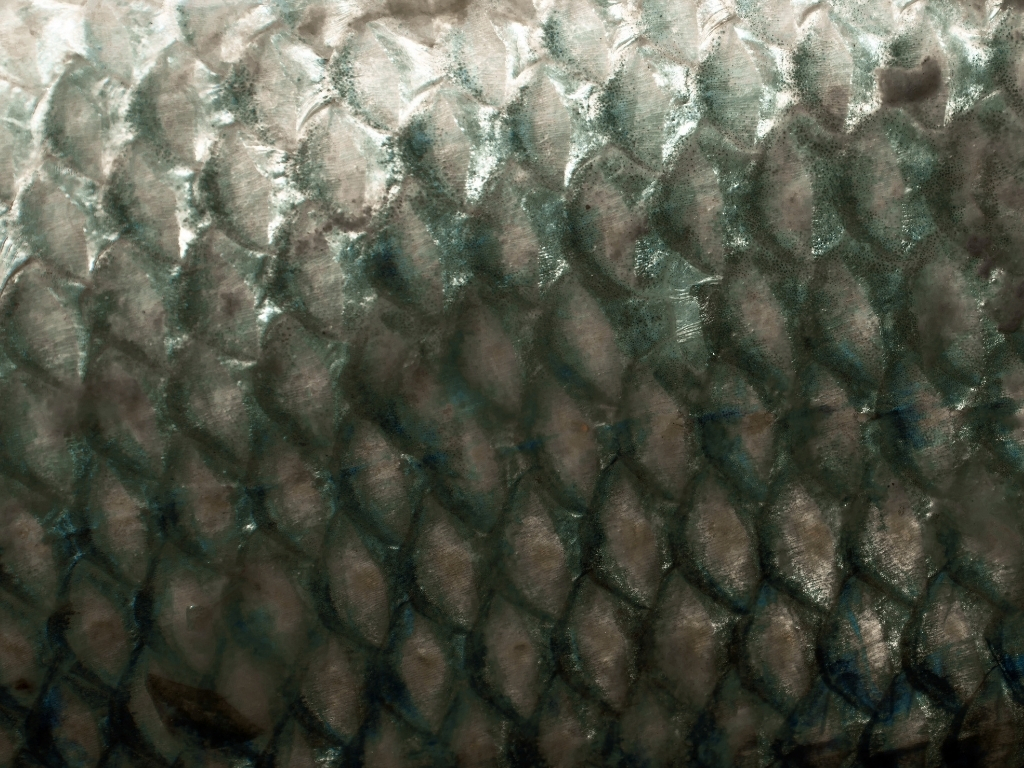
In the far north, past the fjords, something had come down out of the high pine forests and was killing sheep. The king’s men had hunted it for three winters and caught nothing. Where it passed, they found blue scales — as big as a man’s palm, the color of deep ice — and they had taken to bringing these back to the castle in sacks, as proof of progress, the way soldiers bring back arrowheads. The villagers were afraid of the dark.
And one more thing, stuck in the middle of a list of losses, almost nothing: a fisherman had been out on the water at dawn.
In the fog he had heard the creature. He would not say what it sounded like. He said only that the sound carried across the water for a mile, and that it went on and on, and that he had rowed home with his ears covered.
Sewn to the corner of the letter, with a merchant’s tidy stitches, was one of the scales. He had enclosed it for his employer — a curiosity, a trifle, worth nothing.
But Poliphilos cut it free and held it in his palm by candlelight. It was colder than the room. Blue, faintly gleaming, lighter than it looked like it should be.
He read the fisherman’s passage three times. Then he sat with the candle and the scale and was very quiet.
He knew that sound.
Not the same one — the same voice, long before whatever had happened to it happened. Years ago, far to the south, he had done a unkind thing to by-then-unkind being. He had spent the winters since then not thinking about it, and he had gotten good at that. But he felt pain remembering who the unkind being had been.
Now the fisherman’s words sat in front of him on the page, and not thinking about it was no longer working.
There was no invitation here.
That was how he knew the errand was his.
No lord had summoned him, no guild had hired him, no sealed letter requested his judgment.
This was older business.
He packed a saddlebag before dawn, left coin for the monks, and told no one where he was going. The kingdom in the north did not know he was coming. He knew how they would find out.
After this. And they would call him a hero.
He rode north for weeks, the blue scale wrapped in cloth at the bottom of the bag. In the last stretch, through the cold pine country, where the road gave out and became a horse trail and then a footpath, a scrap of music kept coming to him, unwanted.
Seven notes, maybe eight, falling, worn smooth like a pebble in a river — a tune he had never written, and yet knew. It had been his friend’s. The friend had hummed it over his work, over his supper, in the dark, always — it had simply been what he did instead of thinking.
On the last night, at a shepherd’s fire, with fog coming off the black water, Poliphilos hummed the fragment once — and stopped halfway through, because the sound of it in the fog was too close to the sound the fisherman had covered his ears against.
He did not hum it again. But it did not stop coming.
The Kingdom
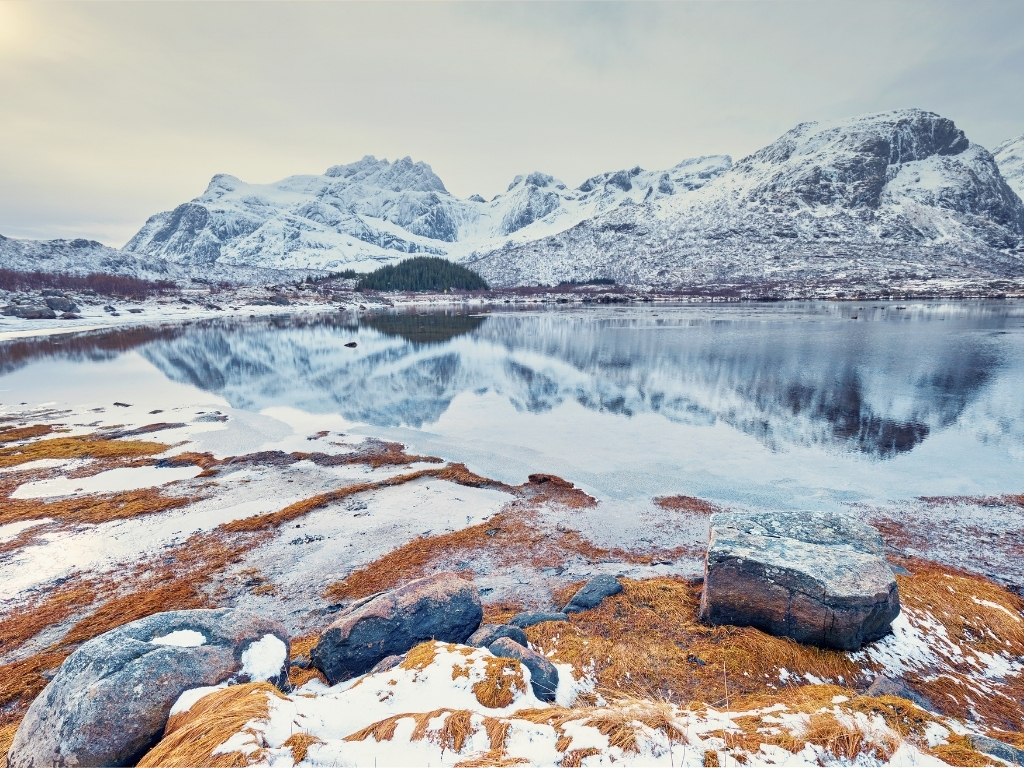
The town at the fjord’s end held winter on its edges the way a cup holds a rim of wine. Pine black down to the water, ice beginning in the shallows, and at the center of everything a torchlit hall that glowed every night like a forge with a social life.
He took a room at the inn and started listening.
It took two evenings to learn the story the kingdom told itself, and two more to learn that nobody doubted any part of it.
The beast had been a villain before it had ever taken so much as a goat — the innkeeper was clear on this, warming his hands at the stove in the manner of a man delivering settled history.
A blight on the valley since his grandfather’s grandfather; strange lights up the ridge in the old days; the king’s huntsmen, now in their fourth winter, would sort the matter out and not a day too soon. On the shelf behind him, in a place of pride between the saints and the good cups, the innkeeper kept one of the blue scales, polished with lard every feast day. He let Poliphilos hold it. It was the same as the one in the letter, and just as cold.
The lord at the hall chattered more brightly.
He was delighted by the beast, in the way of a man whose social calendar has been improved by a disaster, and he had the creature’s crimes organized by season, with months attached, and a theory about its origins. “Conjured”, he said, “certainly conjured, the valley had always known that” — which he delivered with the confidence available only to someone who has never had to check.
The castle, he mentioned, had a whole chest of the scales now. He proposed, when the beast was at last killed, that they be counted among the crown’s treasures.
What the kingdom wanted, Poliphilos concluded over the course of the evenings, was not an end to the beast but an ending to the story. A hero, a head, a church song.
A solution would do, but a saga would do better.
The king’s huntsmen he found at the far table, and they were different from all of it: bored, methodical, three winters deep in a hunt they had underestimated. He drank with them one night, listened to their talk of killsites and cold camps, and understood that they were competent men who had been given a story instead of intelligence.
They wore the blue scales on cords around their necks like pilgrim badges, and Poliphilos kept his eyes on his cup when he saw it. One of them, the quiet one, had equipment finer than any soldier of the crown should own — straps and buckles of a workmanship that belonged to cities these men had never seen — and bore a small crest that Poliphilos declined to look at for longer than politeness required.
Someone had been funding the watching of this valley for a long time, and whoever it was had never once told the huntsmen what their quarry was.
Poliphilos spent four days walking the ridge above the valley, before he told anyone who he was.
The scales guided him better than any hoofprint.
They lay shed along the whole high country, years of them — the old ones gone gray and moss-grown, half-buried, weathered down soft as old coins; the newer ones still blue. Reading them was like reading rings in a stump. They marked out an enormous, almost empty territory — a decade, more, of solitary habitation by something with hands and intentions. Shelters rigged against storms, again and again, each one a little better made than the last and none of them adequate. Stores laid in and raided by wolverines and spoiled and laid in again. Scratched arithmetic on bark, counting something, abandoned mid-row in three different places. Evidence of a mind working steadily inside a body that had gone on finishing without it.
And everywhere, at the borders of it, the signs of desperation sharpening over the years into something the town would eventually, technically, be right about.
He found the killsites. He was not proud of how unsurprised he was.
He knew then what he had come to know. He had hoped to arrive and find the fisherman mistaken, the fog full of ordinary sorrow. He was not mistaken, and the fog was full of the sound, off in the white distance, going on.
The fragment of melody arrived again on the walk down, unprompted, and this time it brought a companion with it — a second phrase answering the first, in a shape his hands already knew.
He stopped in the snow and did not move until it finished.
The Meeting
He told the innkeeper he was going up the ridge to snare ptarmigan — birds, white as snow, good eating if you can find them. The innkeeper looked at him a long moment — longer than the joke deserved — and said the upper valley was no place for snares in this weather, and did not say anything else, and did not mention it to anyone. Poliphilos paid his bill. Whatever the man suspected, he would keep it to himself.
Some men hold what they know the way misers hold coin — close, and happily.
He went alone, in the last hour of light, into fog thick enough to have a texture.
Following his instincts for hours, he arrived, and the beast was waiting.
Not in ambush — Poliphilos had decided long ago that ambush was no longer in the repertoire — but the way one waits for something known to be coming, having heard it coming for a day.
What stood at the edge of the fog was large beyond any telling of it, blue where the fog let it be any color at all — deep-ice blue, the blue of the scales in the sacks and on the cords and polished on the innkeeper’s shelf — misbuilt magnificence, scale and shoulder and a head lowered not in menace but in the posture of something that has been ready for this for a very long time.
Because it knew him.
That was the terrible thing.
The recognition moved through the great shape like weather crossing water — a stillness, an adjustment of the lowered head, and then the sound, the sound from the fisherman’s account, produced once at close range and quietly, and it was his name. Old-fashioned and half of it worn away, but his name.
Because they had been friends.
Many seasons, decades ago, in the south. Poliphilos knew the face beneath the scales — he had not expected to find it here, but he knew who stood before him, the way one knows the voice of a friend through a wall before one has understood a single word. What stood in the fog was what remained after the years, blue-scaled and patient, and it had waited in the cold to be recognized.
Of the man, three things survived.
A thing he still hummed — that was the fragment; the falling seven notes, worn smooth; his friend had hummed it constantly, over work, over meals, in the dark.
Something he kept — up on the ridge, in the best of the shelters, wrapped and preserved with a care the arithmetic had not been given, a bundle Poliphilos did not open and would not describe.
Something he was making, when it started: a plan that included a boat and a route south. His friend had been going somewhere, when the change had taken him, and had never finished going.
The fog around them thickened, and down-valley, faint, the hunting horns had began.
Fourth winter, funded, methodical. Whether the horns had been coming for an hour or a day no longer mattered; what mattered was that they came regardless of anything Poliphilos decided, which meant the decision had been made some time ago by everybody but him.
His friend made the sound again — softer, more of it worn away — and turned his head toward the horns and then back, and held still, and lowered himself, all the way down, onto the frozen ground, deliberately, folding like something at the end of a long walk.
“It’s either you or them, my friend,” Poliphilos said. “Both leave bones in the end.”
His friend nodded, because there was no hope, and it was time.
What Poliphilos did then he did not do as a huntsman, and it was not combat, and there is no version of it that belongs in the telling beyond this: that he knew where, because the two of them had once, in the south, in the year of ordinary days, talked through everything that could ever need knowing about this, as friends do, aimlessly, on late afternoons, thinking it was conversation. He pushed where he knew.
It was quick, and quiet, and it was not brave.
The body — the magnificent blue remainder — came apart with more grace than it had carried in years, the scales loosening and lifting away in the fog like a storm of pale petals, drifting, shedding the weight of the thing in layers, filling the white air around them with slow blue snow. And where the center of him had been, something rose. Not the body’s business; lighter than the fog and brighter; it went up through the whiteness without disturbing it and was gone, and the fog closed over it like still water.
Where the light had dissolved, something fell back. Small. Warm. Poliphilos knelt and picked it up before it had finished cooling: a single scale, the deep-ice blue, strangely light in the hand, holding its heat the way an ember from a hearth holds heat, though there was no fire. He had held its cold twin in a monastery by candlelight, months and miles ago. This one was warm. He dried it on his sleeve, and he put it in the breast pocket of his coat, where it now started warming his heart.
The horns were close when he turned back.
The escort, when it found him in the last of the fog, found a weathered stranger with snow on his shoulders standing over ground strewn with settled blue scales, and they set about gathering these into sacks with the diligence of men who know what the castle pays by weight. There were many. There was no body. But they didn’t ask any questions.
The Aftermath
The kingdom made him a hero before the snow had melted, with the speed and appetite of people who had been holding the position open.
There was a feast, at which he sat at the hall’s edge while the lord narrated the ending of the beast, organized by season, with months he invented while narrating.
There was a toast to the stranger who had come out of the south wind and done what three winters of the king’s huntsmen could not — a version in which the fine-crested equipment and someone’s patient interest in the valley went entirely unmentioned, and in which the beast had died in single combat, roaring, atop a hill the ground did not contain. The church took the story within the fortnight. They would sing something in it about him, the lord promised, responsibly.
Poliphilos declined the credit, in the manner that offends no one at the time: he attributed his success to the huntsmen’s groundwork, to luck, and to the beast being, by then, old.
He declined the reward outright, which offended the lord for exactly one evening.
He declined residence twice.
And he quietly declined the last thing as well — the trophies, the relics, the display.
The castle’s chest of blue scales was to be augmented, the lord had planned, by the scales from the kill-ground, and by whatever the upper valley surrendered: a reliquary, a chapel niche, a banner. Poliphilos talked him out of it over two glasses of the hall’s better wine, in the accent of a man advising on rot in a roofbeam: unlucky ground, he suggested, sacred to somebody probably, beasts that die unlaid do not rest displayed, and the church has its song already, which keeps better than bones do. It cost him nothing to be believed. The kingdom, which had wanted an ending, was happy to be given a mystery instead, at no additional charge.
But that was the chapel, and this was the castle: the sacks went in all the same.
The scales from the kill-ground were counted, weighed, and locked into the chest beside the harvest of three winters, and the quiet huntsman’s patron would eventually be given a full accounting, the way patrons are.
The kingdom got its mystery and its merchandise both, one for the church and one for the treasury, and never noticed the difference. Poliphilos could save his friend from being displayed. He could not save him from being weighed.
He went south on foot, along the coast road, in weather that owed nothing to anyone. The letter’s scale, the cold one, he dropped into the sea from the harbor mole the morning he left. It went down without ceremony, the way a debt settled quietly goes down.
The melody finished itself somewhere in the second day’s walking.
It had been assembling in him the whole way north and all through the valley — his friend’s phrase, worn smooth by years of his friend’s humming, and now, on the cold road, the rest of it arrived: the answering phrases, the shape of the whole, settling into place the way the bundle in the shelter had been wrapped, carefully, around something. He stopped and hummed it through, start to end, in the wind, and understood for the first time what it had been the whole time — not his tune, and not only his friend’s.
His friend’s dreams of tomorrow, hummed on rooftops and over work, in the year of ordinary days: everything he had been going toward, before the change had taken him into the wrong country and left him there. It had been waiting in the music to be finished. It was finished now. Poliphilos was not the author of it and did not pretend to be; he was, at best, its executor.
He took the second scale out of his coat pocket that evening, in the last light, at the roadside, and held it in his open palm, and hummed the completed tune over it once, from beginning to end — because it seemed to him that a thing should be tested in the presence of the one who would know.
It warmed. Faintly, briefly, under the last of the light, like something remembering rather than something burning — and then it cooled back to stone temperature, and lay in his palm the way a scale lies, and he did not investigate further, then or ever. He knew what it was for. It was not for study.
He put it back in the breast pocket, where it again rode against him warm for the rest of the walk, or seemed to — it was difficult, after enough days of cold road, to be sure which warmth was the pocket’s and which were the body’.
And he went on south, one warm scale in one coat pocket, and nothing else from the north but the tune.
Some friendships never make the records — no crown’s chest, no church’s song. They live on in melodies, carried out, not displayed. Join Those Who Know.
Leave a Reply