

Introduction
A king playing chess with a student (or peasant) in the middle of the night, while two dogs fight in the corner—this medieval woodblock print from Pérez-Reverte’s “El Club Dumas” provides an example of several forms of power in action (French and Raven, 1959).

In addition, the positioning of the characters in the picture invites us to either identify ourselves with the student in the situation if you are accustomed to experience power dynamics from lower statuses or see every other element in the picture as obstacle. But you may also identify yourself with the king if the application of the different forms of power is familiar to you. This setting is consistent with Tajfel & Turner’s (1979) Social Identity Theory‘s prediction that subordinate groups develop distinct cognitive strategies for navigating hierarchical systems.
Third, the image’s crucial detail—a completely uniform chessboard—represents what we term “artificial equality structures” in organizational psychology. This aligns with Schein’s (2010) concept of espoused versus enacted values, where organizations create formal systems that appear egalitarian while maintaining underlying power asymmetries.
But what is the game here?
The completely uniform chessboard, either all white or all black depending on which version of the image you have means that it isn’t normal chess.
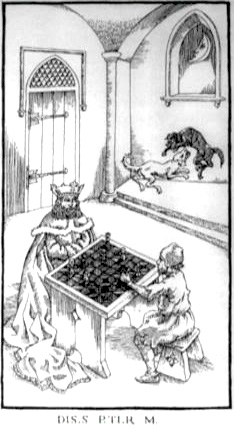
A uniform board suggests the game is rigged for a draw, creating artificial equality where none naturally exists. Within this construction, the king cannot beat the student and vice versa. They may not be equal in reality, but the game itself has been manipulated to deliver an even result.
But who has manipulated it? The king, who’s ready to retire, teach the student a lesson or to get rid of the student, or the student who wants to beat their opponent, to prove their point or to escape to freedom? The picture provides no answer for this.
But what it does provide is an advantage to the student. As a learner of the game they have a chance to surpass the king through unconventional means—perhaps by rigging the very system that was meant to contain them.
But isn’t this cheating? Or perhaps it’s an attempt for the student to get out of the situation? Perhaps they we can take the student as a corporate employee who have quiet quitted and are no longer interested in the game of business?
Historical Context: Chess as Medieval Power Symbol
Chess arrived in medieval Europe through Islamic Spain around the 10th century, quickly becoming the preferred game of nobility. Medieval chess symbolism frequently appeared in manuscripts and art, representing the cosmic order, divine hierarchy, and earthly power structures.
The uniform chessboard in our image subverts this traditional symbolism. Where chess typically reinforced social hierarchy—kings commanding pawns—this version suggests that hierarchy can be manipulated by those clever enough to change the rules rather than simply play by them.
Medieval artists often embedded such social commentary in religious and secular works, knowing that symbolic language could communicate ideas about power and transformation that direct statements could not. Similar activity continues today. See, for example, how a stonemason secretly carved a Xenomorph from the Alien franchise into a 700-year-old Scottish church in the 1990s.
There’s more
Even if the student manages to finish the game, there are three more obstacles.
First, those fighting dogs are not just decoration. In medieval symbolism, dogs could signify loyalty and protection, but also base instincts and fears. Here, their conflict represents the internal struggle that accompanies transformation—the fears of the mind that arise when we approach change.
Carl Jung would recognize this as the shadow work necessary for individuation. The dogs symbolize our resistance to growth, the part of us that prefers familiar limitation to uncertain expansion. They must be overcome so that we can continue our journey forward.
Second, there is a door and it’s closed. But as it is not locked it signifies that the student has a chance to exit the situation if they just conquer their fears.
Third, the night outside adds another layer of complexity. Darkness offers both protection and threat, so this particular journey of the student actually leads to the unknown. This is because darkness is ambiguous as it provides both a risk but also protection. Night represents the unconscious realm where transformation occurs, but also where our deepest fears reside.
The Creative Process: From Medieval Print to Modern Cover
The inspiration for “Ancient Manager” came to me in 2016 at the Finnish National Opera, watching a modern adaptation of Wagner’s “Flying Dutchman.” Instead of the North Sea, the story was set in a New York art gallery. I thought to myself: “I will make something like that one day.”
When I later discovered this chess image in Pérez-Reverte’s novel, I recognized its relevance to the song I’d been developing—an old-guard executive facing a new generation manager, wondering whether adaptation is possible or if resistance is inevitable.
For the cover art, I worked with photographer Maria in our local 18th-century museum’s Empire Hall. The setting was perfect: Napoleonic empire style with that distinctive “poison green” color we call it in Finland—originally achieved with arsenic-based paint. There I was in my signature dark suit and sunglasses, playing chess with Maria’s 7-year-old daughter in this 18th-century environment. A child of the 2000s playing a rigged game with a man born in the 1970s, surrounded by empire décor from the 1810s.
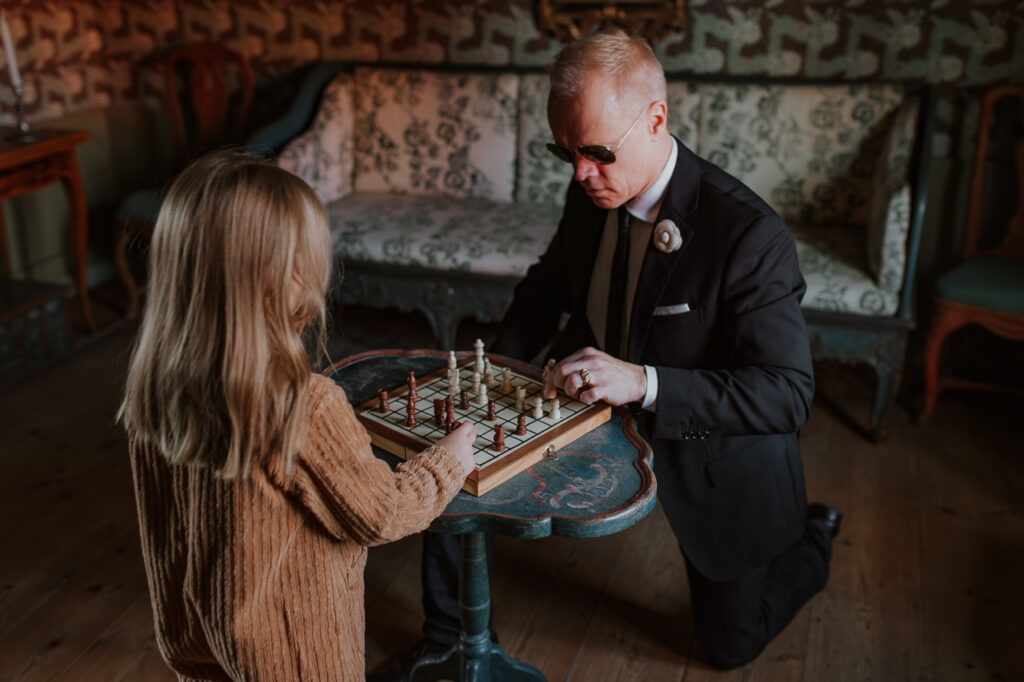
Since I’d never seen a uniform chessboard, I had to create one myself. I borrowed a normal board from a friend, bought cardboard and a felt pen from the local bookstore, then painted the squares black on one side and drew white squares on the other. The handmade look matched well with the empire interiors—known for being handcrafted by carpenters, unlike the mass-produced Biedermeier style that came ten years later.
We had to work quickly because the 7-year-old grew restless, but she played her part beautifully before Maria had to take her home. Maria returned later for additional shots of just me against the empire decoration.
Later, I discussed the artistic expression of the photos with my friend who’s a theatre director and choreographer, and the discussion circled around how middle aged white, western men can today express themselves in a world that has heard their story a thousand times and demands for more diverse stories to be told. I’ve decided since to draw unapologetically from European cultural heritage, because imperialist as it may sometimes be, there actually is tremendous diversity if you know where to look.
Questions for Modern Navigators
As you encounter your own chess games—whether in corporate boardrooms, academic institutions, or personal relationships—consider these questions:
Where do you see artificial equality masking real power dynamics? How might unconventional thinking provide advantages that direct confrontation cannot? What fears (your fighting dogs) arise when you contemplate changing the rules rather than simply playing by them? What gam can you rig to your favor?
The artist who created this image understood that transformation requires both courage and cunning. They embedded this wisdom in symbolic language, knowing that those ready to see would recognize the pattern.
The Continuing Journey
This analysis represents just one thread in a larger tapestry of cultural patterns that repeat across time and geography. Each medieval symbol, each artistic choice, each narrative structure carries forward insights that remain relevant to contemporary challenges.
The question our ancient manager poses remains: As the world changes, are we able to change with it? The answer may lie not in fighting the game, but in understanding how to reshape it from within.
For those interested in exploring similar pattern recognition discoveries, these investigations continue on my Memory Keepers email list. Not yet a member? Click this to join!
Listen to “Ancient Manager“
Read the lyrics to “Ancient Manager”
Read the fictional story of how Poliphilos found the idea for “Ancient Manager”
Read about the creative process of “Ancient Manager”
Leave a Reply